


The other morning I was late again, rushing to my trainer down the windy street, hair wild and whipping into my face. I felt my wrists: no hair tie. I wished I had remembered one. I imagined how I would pull my hair back right now, and tidy it up.
Thirty seconds later, my eyes noticed something on the sidewalk. My first reaction: gross - someone littered their personal items. Germs. Yuck.
But then I looked closer. It was a perfect pink satin mini-scrunchie. The exact high quality brand I use. Not some crusty old elastic. I realized: This is for me.
Gratitude flooded in. I picked it up, tied my hair back, and felt the quiet thrill of participation.

Of course, I could degrade the moment. Coincidence. Pattern-seeking primate brain. The rationalists would file it under “selection bias” and move on. But the world is stitched with these small observations if you let yourself see them. And for a second there, I almost didn’t.
This is how it starts. Not with a laboratory epiphany or a thunderbolt from the sky, but with pink satin on concrete. These moments pulled me back into the double-slit rabbit hole with fresh hunger — because what if observation isn’t passive recording? What if it’s participatory? What if the universe actually responds when we truly look?I’ve carried this suspicion since I was a kid trying to make the subway doors open in front of me with my mind. The adults talked me out of it, of course. “That’s not how the universe works,” they said. Reality was concrete, measurable, and definitely not beholden to a dreamy child. But the suspicion never fully died.
It flickered back to life when I read Fritjof Capra’s The Tao of Physics as a younger adult — that gorgeous bridge between quantum strangeness and ancient wisdom. It cracked wide open years later in a philosophy class with Dr. Peter Sjöstedt-Hughes. He was lecturing on panpsychism, idealism, Spinoza, Nietzsche, and Whitehead — how materialism isn’t reality, just one theory among others. I sat there speechless, tears welling up, probably looking like a complete turnip. He must have thought I was odd, but inside I was reeling with validation. It’s actually okay to question this? I looked around the room, stunned. Is everyone hearing this? Materialism isn’t reality — it’s just one theory among others. That class gave me the permission I didn’t know I was starving for.

So I went back to the physics with new eyes. Not as a scientist trying to prove a theorem, but as someone who’s been haunted by moments the official story dismisses as coincidence. The question that kept pulling me in was this: how do we honestly weave together what philosophy and direct experience tell us about the universe with what the scientists have recorded? What if the universe is participatory? This isn’t some fringe notion — it’s what the double-slit experiments and the long strange history of quantum mechanics have uncovered, echoing ancient cultures that understood reality as a dream woven by perception
Centuries of double-slit experiments, the cornerstone of quantum physics, suggest observation creates reality. Yet mainstream physicists lean on the idea of “decoherence” to explain it away, keeping the physical world solid and predictable. I’m here to argue that decoherence is a convenient workaround — a mathematically slick but hollow patch propping up physicalism: the belief that reality exists independently of us.
Maybe I’ll slow down here because most people haven’t even heard of “physicalism” — that’s because they’re living in it, like a fish in water. In the West, at least, we’ve been raised in a physicalist model that implies we can use measurement and observation to make repeatable, predictable models of the matter in the universe. Sounds rational.
By extension, this implies that consciousness — our seemingly magical ability to perceive, think, dream — emerges from matter, from the brain; once the brain stops firing, consciousness disappears. The entire field of neuroscience supports this premise, finding ways to show that brain neurons use mechanical switches to make us distinguish the smell of a rose from a rotting carcass. This is a completely standard and dominant worldview, and the name for it is physicalism or materialism. (I try not to use “materialism” because people over-identify it with conspicuous consumption — and while related, it’s clearly not the same thing. You can be a materialist without having a Gucci purse.)
To understand this argument, we’ll have to start at the beginning.
The Double-Slit Experiment: Light’s Big Secret
Technically, the first double-slit experiment was demonstrated by British polymath Thomas Young in 1801. He noticed that sunlight filtered through a 1mm pinhole in his window shutter in a dark room created a partially coherent beam and spot of light.
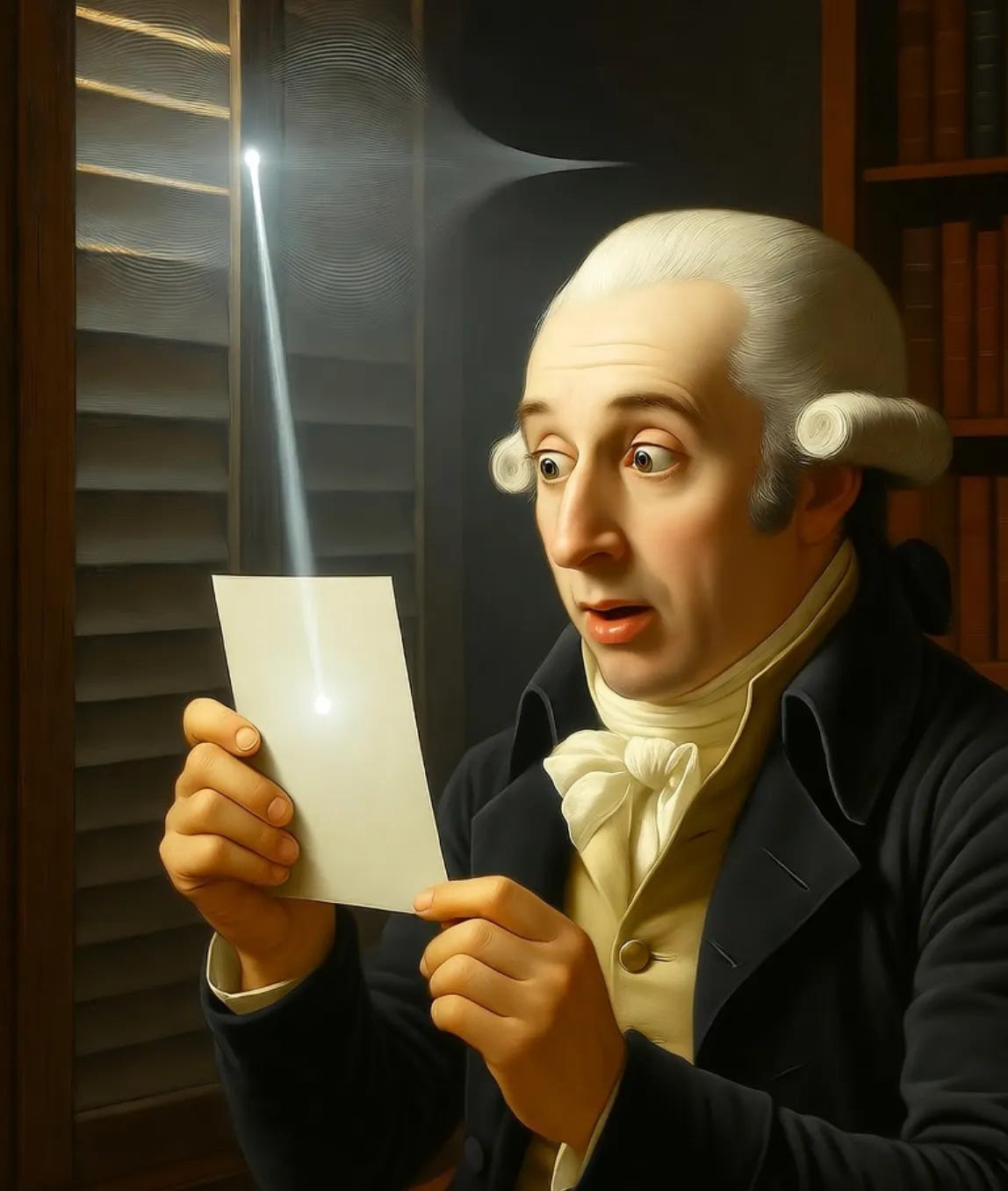
Then he extended the pinhole to a slit, to allow more light through so he could better see the results. The light created a corresponding single-slit pattern on the card behind. Finally, Young cut a second slit and assumed he would see two corresponding patterns of stripes of light on the card behind. But he got an unexpected result, and that’s why we’ve ended up down this whole rabbit hole.
Instead of two stripes of light, Young observed many parallel bands — which demonstrated to him that light is not made up of particles, but of waves that interfere with each other, canceling each other out in one stripe and reinforcing each other in the next. Water forced through two slits in the same way creates an identical pattern, which is easier for us to visualize since we’re familiar with the wave characteristics of liquids. The pattern of many parallel stripes created by waves is called “the interference pattern.”

Like anything that challenges the mainstream paradigm, Young’s discovery was met with skepticism and outright hostility. The most notable attack came in 1803 from Henry Brougham, a devotee of Isaac Newton’s longstanding corpuscular (particle) theory of light. In the Edinburgh Review, Brougham accused the wave theory of being the product of a “boyish and prurient imagination” and lacking any merit. Young subsequently lost a book deal and, in frustration, temporarily pivoted back to his medical practice — a historical footnote reminding us that cancel culture is hardly a new product of social media.
After that disgrace, nothing much happened for over a hundred years. But then, in 1909, young British physicist Geoffrey Ingram Taylor became curious; he got the idea to try the double-slit experiment again with a substantially weakened light source. Instead of using sunlight, he used a gas flame so attenuated that it only emitted one photon at a time. A photon is just the smallest possible packet of light that can register on a photographic plate. Over a very long exposure, Taylor was able to create the interference pattern (multiple parallel stripes) on a photographic plate behind the double slits — officially confirming Young’s experimental results.
Was there fanfare? Nope. The physics world shrugged.
But as technology improved in the 1920s and more precise versions of the double-slit experiment were able to confirm the theory that light sometimes acts as a particle and sometimes as a wave, physicists like Albert Einstein and Niels Bohr became pretty interested. It was such a curious problem: how could something be a particle when there’s one slit, and then a wave when there’s two slits? It seemed to destroy Newtonian physics. How could one particle split coherently through two slits and interfere with itself without violating the laws of energy conservation? It’s an impossible situation for a physicalist — which is basically what a physicist studies: the properties and laws of the physical world.
The Observer Crashes the Party: Heisenberg, Bohr, and Copenhagen Chaos
The first person to accept this and really think out of the box — like waaaaaaay out of the box — was German theoretical physicist Werner Heisenberg. His 1927 Uncertainty Principle was a thought experiment demonstrating that precise measurement of the position (spying on a slit) disrupts the wave function, collapsing the superposition into two bands. He used algebra, Planck’s constant, and all sorts of accepted principles that seemed to make it make sense.
Weird? Sure. But his contemporary, Danish physicist Niels Bohr, ran with it. In his September 1927 lecture at the Como Conference in Italy, Bohr proposed something so radical and outrageous that it didn’t even fit into physics at all. His suggestion: the observer’s experimental choice dictates wave or particle behavior.
Bohr and Heisenberg theorized that single photons would interfere (wave-style) unless “spied” on — that measurement itself was forcing a state choice. But then they took it even further. They theorized that any type of observation forced the system to “choose” a state.
Cue: doubt and ridicule from Einstein et al.
Interpreting the results of the ongoing double-slit experiments led physicists outside the boundary of physics into really theoretical and impossible territory. Tempers flared! Einstein had ongoing debates with Bohr in the late 1920s and into the ’30s, arguing that quantum mechanics’ observer-dependent reality (waves collapsing into particles at observation) defied an objective universe — meaning it was a ludicrous idea since it was clear to all that the “elements of reality” exist independently of human thought or observation. Bohr was equally perplexed but accepted the role of observation — insisting that reality is undefined until measured. Bohr’s analysis contributed to the “Copenhagen Interpretation,” which posits that quantum systems (waves in the double-slit experiment) remain in superposition until observed (or measured, which is a form of observation) — and only then do they collapse into definite states.
Physicist Erwin Schrödinger was with Einstein — it was absurd to consider that observation determines outcome. He created his famous cat-in-the-box thought experiment in 1935 to highlight the ridiculousness of the Copenhagen Interpretation. In the “Schrödinger’s Cat” thought experiment, a cat is placed in a sealed box with poison, and we are supposed to believe we have no way of knowing if the cat is dead or alive until we open the box — and what that means is that instead of already being dead or alive, the cat is in a superposition — a state of being both dead and alive until observed.

For a physicalist audience, this was literally impossible to imagine — and therefore a false proposition. While Schrödinger created this thought experiment as a troll to highlight the absurdity of the concept, it remains the greatest metaphor for explaining what is actually going on in quantum systems. What Schrödinger wanted instead was more study, more calculations, more research — anything to explain away the Copenhagen Interpretation.
Decoherence: The Physicalist’s Hot Chocolate Remedy
Physicalists needed an out. Enter Heinz-Dieter Zeh, a German physicist who, in the 1970s, introduced the theory of “decoherence” to address the perplexing implications of the double-slit experiment and Schrödinger’s Cat. He proposed that an entirely physical mechanism was what made a photon “materialize” and act like a particle (creating two bands) — and this could happen when a photon bumped into the added molecules of the detector or the errant air molecules around it. He claimed quantum systems lose their wave-like superposition not through observation, but through physical entanglement with their environment — like air molecules or detectors. Zeh took a metaphysical problem and “solved” it with a physical remedy — a bit like solving a nightmare by drinking a mug of hot chocolate. But it seemed to work! And they could build reliable, repeatable math around it. All the physicists of the world let out a collective, delirious sigh of relief.

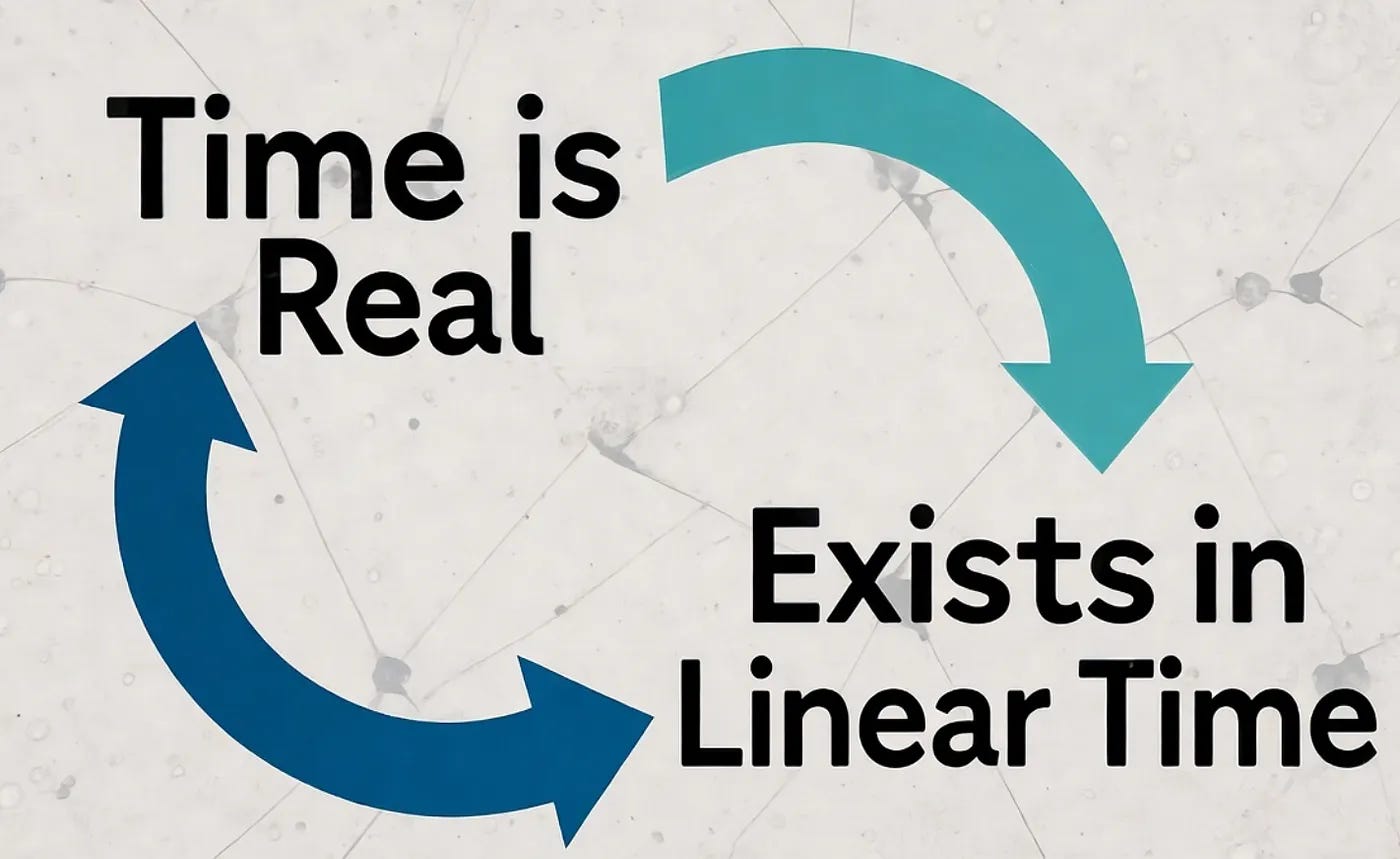
With decoherence, the wave collapse happens at the time the wave is measured by the detector because of the physical interaction, not when the human later checks in on the experiment. And this is the shaky point of disagreement, because no one can ever actually know when the collapse happens. We assume linearity because we can only perceive linear time. But this is a deep, unconscious bias. This is circular reasoning.
Scientists, wedded to the idea of an objective, observer-independent reality, can only interpret quantum weirdness through that lens alone. They assume the environment “selects” a classical outcome (two bands) because that’s what we later observe, then claim decoherence explains it simply because it produces classical outcomes. This is begging the question: the conclusion (classical behavior) is baked into the premise (environmental entanglement causes classicality). Decoherence doesn’t solve the measurement problem — why one specific outcome occurs no matter when a human finally checks the results — because it’s too busy explaining how systems look classical, a question no one asked.
The alternate explanation would mean that observation only happens when a human finally checks in on the results of the experiment. Whether that is 5 seconds after the experiment or 1,000 years later, the results will be consistent and will be entangled with whether or not there was a detector being used at the time of the experiment.
That’s not because of the detector’s physical interference; it’s because the detector is the opening bracket of observation — a bracket that can stay open as long as it takes until it’s closed by human observation. The spying (detector) and looking (final observation) are entangled across time, retrocausally fixing the two bands on the photographic plate. Without human observation, the state of the photon or electron remains in superposition. The cat is both dead and alive until we look.
The Reporting Problem
Maybe by now you can imagine how hard it is for journalists to write anything substantive on developments in the double-slit experiment — I’m already thousands of words in and I’ve barely gotten to the meat of my argument. This topic is so foreign and requires such a vast reservoir of shared knowledge just to get everyone on the same page.
The meat of my argument is that just because “decoherence” works (beautifully! elegantly!) doesn’t mean the solution is correct.
Experiments Don’t Prove Decoherence — They Prove Observation
Sure, decoherence is mathematically rigorous, derived from quantum equations. It predicts two bands in double-slit experiments and errors in quantum computers. But rigor doesn’t equal truth — it’s a model, not reality. Its circular reasoning assumes physicalism (an objective world exists) and linear time (patterns form “during the run”).
And yet, physicists continue to claim decoherence fixes the two bands without human observation. In Tonomura’s 1989 double-slit experiment, single electrons hit a photographic plate, forming a latent image (chemical changes in silver halide crystals). With a which-path detector, the plate shows two bands, consistent whether developed immediately or years later. They say this proves a physical record exists, set by entanglement with the detector’s “quantum state” (its measurable properties, like photon absorption). Similarly, Merli-Pozzi-Missiroli (1974–76) showed electrons on film forming two bands when spied on, and modern setups with digital detectors (e.g., CCD cameras) log consistent signals. Quantum computing experiments show decoherence from environmental noise, producing errors without human eyes. To a physicalist, these seem to show decoherence is real, and observation isn’t needed.
But they miss the point. In the very same experiments, we have no way of knowing about errors until we become consciously aware of them. We assume they happened earlier along a linear timeline, but we have no way of going back in time to check. We only know the two bands at the time that we look. The plate, detector, entire experiment is indeterminate — maybe even nonexistent — until observed. There’s no proof of chemical changes or digital signals without looking; development or analysis requires observation. If you destroy the plate before looking, there’s no result — observation never completes.
Consistency proves my point: spying is observation, entangled with looking, retrocausally fixing two bands on the photographic plate.
The universe knows it’s being watched, as philosopher George Berkeley said, “To be is to be perceived.” We can’t hide spies from the universe — it’s hubris to think we can.

These experiments aren’t proving decoherence at all — they’re showing the exact opposite. We simply can’t know what “happened” until some aware mind looks at the results. Until then? Quantum limbo.
You might say it doesn’t matter whether it’s physical decoherence, or that “looking” is entangled with “spying” — since both come up with the same outcome of two parallel bands, as if the electron is a particle. It’s the same result, so why quibble about how it got that way?
Why? Because the answer tells us emphatically and profoundly how the universe actually works. The universe does not always follow objective physical laws — rather, it is determined by our observation.
Wheeler’s Delayed-Choice Twist and the Participatory Universe
It’s probably time for American theoretical physicist John Wheeler to enter the chat. He was a protégé collaborator of Niels Bohr, made seminal contributions to nuclear fission and general relativity, and coined the terms “black hole” and “wormhole.” Not just a scientific superstar, but a science fiction god. He took the double-slit saga to the next level by proposing far-out “delayed-choice” experiments involving a photon from a distant quasar traveling billions of years to get to Earth, gravitational lenses, switchable beam splitters, and experimenters who get to decide outcomes after the fact.
Although this cosmic version hasn’t been (and cannot be) performed, labs have tested and confirmed his hypothesis dozens of times since 1984, from tabletop photons to a 2017 satellite-ground link spanning thousands of kilometers in space. Quantum weirdness doesn’t need a galaxy to prove it’s real.
Wheeler’s deep understanding and incredible imagination led him to pioneer the idea of a “participatory universe,” where consciousness plays an active role in shaping reality. He saw observers as co-creators.
So where does all of that leave us? Decoherence may be clever, but it doesn’t close the case. It explains away the weirdness without actually addressing it. The “measurement problem” remains unsolved because at its heart it asks a question physics has been reluctant to face: What is the role of consciousness in the universe?

Wheeler’s “participatory universe” hangs over the whole debate like a neon sign: observers are not bystanders; they are participants. The universe is not “out there” independent of us — it is entangled with us, shaped by our participation. Every act of observation is not passive but generative.
The Hard Problem in Disguise: Decoherence’s Circular Dodge
Decoherence keeps the comfort of physicalism intact while brushing past the more radical implication — that reality may not resolve without awareness. Ancient traditions have said this all along, from the Vedic insight that “the world is mind-made” to Indigenous dreamtime cosmologies that frame existence as co-dreamed. Physics has now circled back to the threshold those philosophies already inhabited.
Maybe the real discomfort isn’t that particles act like waves until observed. Maybe the real discomfort is that we are not mere spectators in the cosmos, but co-authors. Which means reality is less a machine, more a dialogue.
Decoherence might patch the crack, but consciousness keeps shining through. And whether we like it or not, every question we ask, every glance we take, is part of the script the universe is still writing.

Conclusion: Retrocausality, Intuition, and Co-Authoring Reality
We can’t keep pretending that photons bumping into air molecules or detectors is the full story.
Decoherence isn’t just technical hairsplitting — it’s about whether we accept a universe that exists fully without us, or whether we admit the more unsettling possibility that the universe waits for us to look at it before deciding what it is.
Physicalism keeps things comfortable, predictable, measurable. But the deeper truth may be stranger: the world is not “out there” independent of us — it is entangled with us, shaped by our participation.
And what that means is that every act of observation is not just passive, but creative.
Every glance, every measurement, every question we pose is writing the script of the universe in real time. And even though it might appear to be entangled with whenever the observation window began — it’s all happening right now, and only now.
The adults tried to talk me out of it. The rationalists and physicalists still do. That’s their journey. But I’ll keep noticing the pink scrunchies - and the quiet ways the world seems to respond when I pay attention.