

When I was six I asked my parents a question they couldn’t really answer, and the forty years that followed were the long version of answering it for myself.
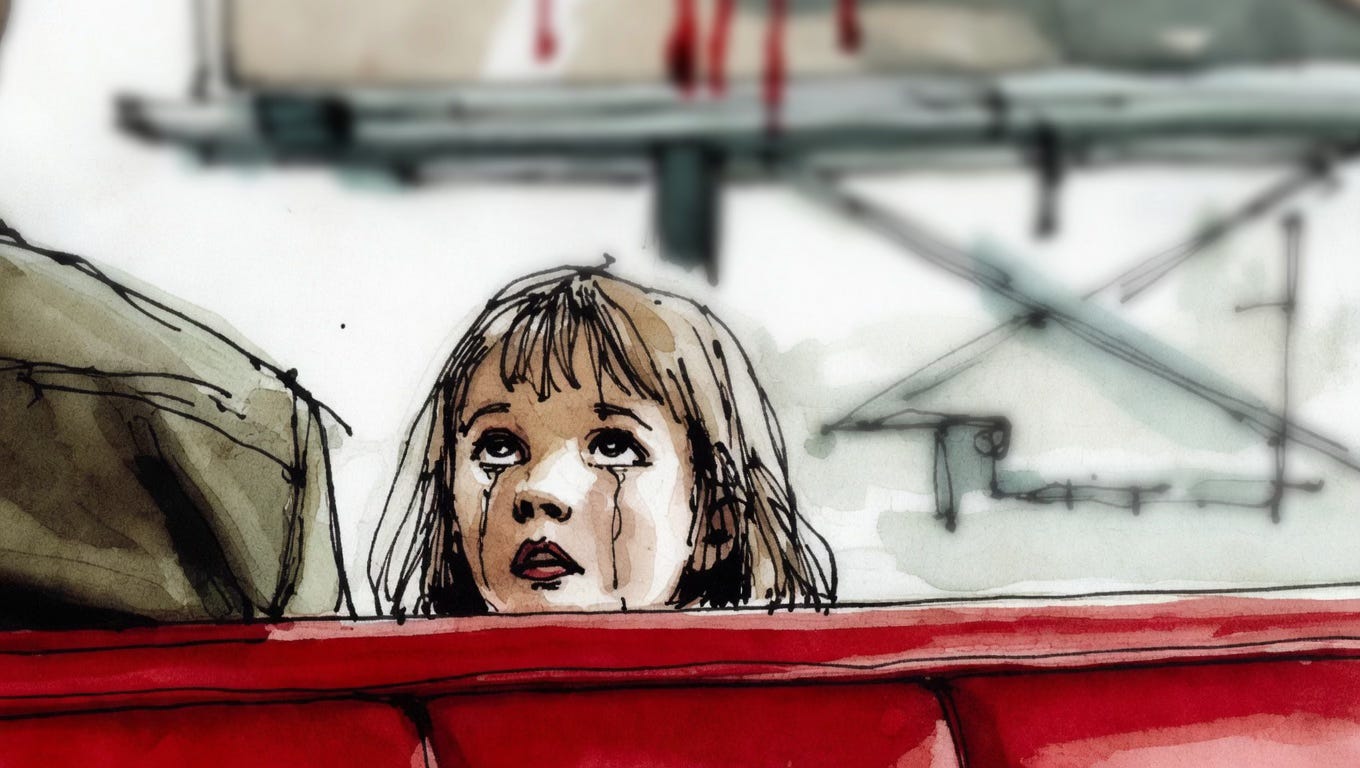
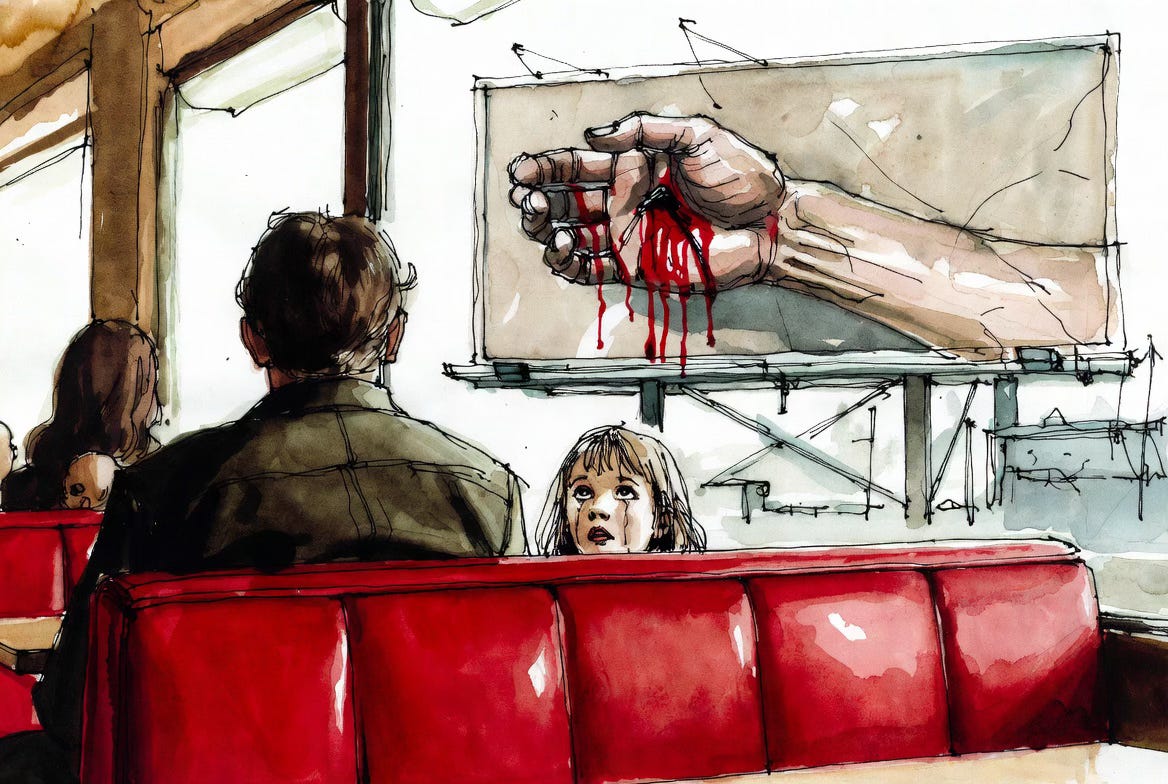
My parents had taken me and my baby sister out for Chinese food. We sat in a red vinyl booth by the window. Across the street was a billboard I couldn’t look away from. I have no memory of what it was advertising — Latter-Day Saints, probably, or one of the church campaigns that bought up Toronto billboard space in the early eighties — but I remember the image: a close-up of a nail going through a wrist. Jesus’s wrist, nailed to the crucifix. The blood was oozing rather than spurting, which made it worse. His expression of agony was specific. Not generalized suffering. A particular man, in a particular minute, in genuine pain.
I asked my parents what was happening to him, and how anyone could cause suffering like this. And if Jesus was God’s son, why couldn’t God stop it? How was God so powerless? And more importantly to me, how could a parent let this happen to their child? I didn’t have the words to describe how I was feeling, and I started crying. Not crying — sobbing. Sobbing like my dog had just died, like I would never get over this thing, never understand.
The answer I got from my secular parents was that God had let it happen. He let his son be killed as an ultimate sacrifice to end all sacrifices. He let it happen because of the value of this idea.
I sat with my soggy egg roll and stared at the billboard. I was six, and I understood, in the way a six-year-old understands things before she has the language for them, that an idea worth dying for must be a very large idea. Larger than a person. Larger than a body. Larger than the rules I was already learning about not running out into traffic and saying please and thank you and being good.
And then — and this is the part I have spent forty years trying to put into adult words — I understood the idea itself. Not as theology. As a flat fact about how the universe must be arranged. The man on the billboard had let them destroy his body because he wasn’t his body. That was the whole point. If he had been his body, the death would’ve been the end of him and the story would’ve been a horror story. But the story wasn’t being told as a horror story. It was being told as a triumph. Which meant the body wasn’t where he actually was. Which meant the body wasn’t where I actually was, either.
I thought: so we are not just this.
That was the night the tailspin started. It lasted forty years.
I grew up in a Toronto that was modernizing, progressive and proudly atheist. The intelligent kids all mocked religious people — the way you might mock someone who still believed in the tooth fairy. I read Dawkins in my twenties and nodded along. I memorized the arguments. I took up positions out of allegiance to reason, because reason was the side the smart people were on, and I wanted very much to be on the side of the smart people.
But underneath all that, the question from the booth had never closed. So we are not just this. I couldn’t get the sentence to go away, and I couldn’t find anyone who would take it seriously. The adults in my life were uniformly kind, well-educated, and absolutely certain that the question was a category error. There is no more. There is only this. Be useful. Be productive. Don’t be weird.
So I was useful. I won the high school prizes. I got into every school I applied to. I got every job I interviewed for, and then I got promoted, and then promoted again. From the outside it looked like a life unfolding correctly. From the inside it was a slow, careful demonstration that none of it touched the thing I actually wanted to know. The more I succeeded, the more clearly I could see that success wasn’t the answer to the question. It was a very polished way of not answering it.
I spent a big part of my twenties drinking excessively, exploratorily. I didn’t drink to be numb; I drank to get around my limiters. Sober Swith was constrained by every rule she’d ever absorbed about being good and performing competence. Drunk Swith was not. Drunk Swith said the wrong things and did the wrong things and got involved with the wrong people, and the next morning I’d hear what she’d done with a kind of horrified curiosity. Who is that. I tried to mistake that drunkenness for freedom. It kind of felt like freedom, which at the time was close enough. But I wasn’t trying to escape my life, I was trying to find the edges of it.
There were prescriptions. There were the kinds of prescriptions you take when you’re trying not to be the kind of person who needs prescriptions. There was a long stretch where I assumed the hollow feeling was a chemistry problem, because I’d been raised to assume that everything was a chemistry problem. The thinking went: if I am sad in a world that is fundamentally meaningless, my sadness must be a malfunction, because the world being meaningless is the baseline and the only acceptable response to a meaningless world is to be functional inside it. So we medicate the sadness, and we get back to work.
This is the part where I want to be careful. Medication and psychiatry have their place. Can’t get out of bed to attend your dad’s funeral? By all means, take a Xanax if it gets you to the ceremony. Drugs can be a lifesaving bridge in the short term. But the idea that they can correct a “chemical imbalance” is just wrong. Every form of treatment ends up trying to make you better at tolerating a world you suspect is wrong about itself. And that creates a particular kind of suffering. It’s the suffering of being right about something you can’t articulate, while everyone around you, with great love and great competence, is helping you to stop feeling it.
The first crack of light came in second year of university. I’d been reading about physics and space for fun since high school — I loved the perfection of the equations, I loved the elegance, I loved that it seemed to be answering questions of a serious enough size — and I came across Fritjof Capra’s The Tao of Physics. This was 1993-ish. The book is unfashionable now. It was unfashionable then. But it was the first time anyone showed me that the only language I’d been raised to trust — physics, measurement, repeatable experiments — was pointing at exactly the thing the billboard had been pointing at when I was six.
That the universe isn’t made of solid things. That observation isn’t passive. That the people who had been the most rigorous, the most committed to evidence, the ones whose authority I’d been raised to trust above all others, had walked themselves to the edge of an experiment and looked over and seen the same thing the mystics had been saying for three thousand years.
I can’t describe to you what that did. I was nineteen. I’d spent thirteen years trying to convince myself the question from the booth was a child’s question. Capra told me, casually, that it was the only serious question physics had not been able to put down.
It took me another twenty years to do anything about it. There was marriage and my career and then children and several more rounds of trying to make the chemistry version of myself work. But Capra was the first crack, and the crack never closed.
So here’s where I have landed, at fifty-one, and I want to be careful about how I say it because the way it usually gets said has become a wellness slogan that I refuse to repeat.
The world is not a solid thing happening to me. It is a participatory thing happening through me. The body I’m writing this with is a vehicle, beautifully made, worth maintaining, but it’s not the cargo. The cargo is the awareness inside it — the thing that has been asking the same question since the red booth — and that awareness is not separate from whatever runs everything else. Jesus called it the Father. The Vedas call it Brahman. The physicists who can’t bring themselves to use spiritual language call it the field, or the underlying substrate, or the place the wave function comes from. They’re all pointing at the same thing. I am made of it. So are you. So is the chair you’re sitting on.
I want to be frank about what this means in practice, because I’ve read too many essays where someone arrives at a worldview like this and then doesn’t tell you how it changed their daily life.
It changed everything.
I don’t fear death the way I used to. Not because I have certainty about what comes after, but because I no longer believe the body’s ending is the operation’s ending. I look after the body — I eat well, I move, I sleep — but I’ve stopped confusing the vehicle for the journey. I attend differently. I treat my own attention as the most consequential thing I own, because attention is what awareness does, and awareness is what I am. What I attend to becomes more real. What I turn away from dissolves. I’m still working out whether that last sentence is true in the strong sense or whether it’s a useful approximation that has the side effect of making the person who believes it suffer less. The honest version of my belief includes that uncertainty.
I treat other people differently too. If the body is a vehicle, then the person across from me is also awareness wearing a body, and the body they are wearing — its mood, its bad day, its grievance against me — is not the thing I’m actually talking to. This is harder to do than it sounds. I fail at it constantly. But the failures are interesting now in a way they weren’t when I thought the body was all there was.
The version of me who was loyal to the physicalist worldview was miserable. The version of me who lives this way is not. That’s the only data I have direct access to.
I know how this sounds coming from where I’m sitting: Happily married, mother of three, living in safety and security, with time enough to dream and write. A deluded, well-fed white woman who has the luxury of believing her attention shapes her world because nothing has come along to disprove it.
I have sat with that accusation for a long time, and all I can say is: I have what I have because I came to see the world this way. Not the other way around. I cannot prove this to you. I am not even going to try. I am just going to tell you that the order of operations matters, and the people who think I’m writing from a position of comfort have the timeline backwards.
The kid in the red booth was right. I’m forty-five years late getting back to her, but I’m here now. The question hasn’t closed.
The next essay will be about the physics.
— Swith