

When I was eight, I read The Wonderful Story of Henry Sugar for the first time. I have no memory of that first reading because I read it so many more times after that — dozens of times alone, then with my own kids — and the readings have all collapsed into one continuous reading that lasted roughly the length of my life.
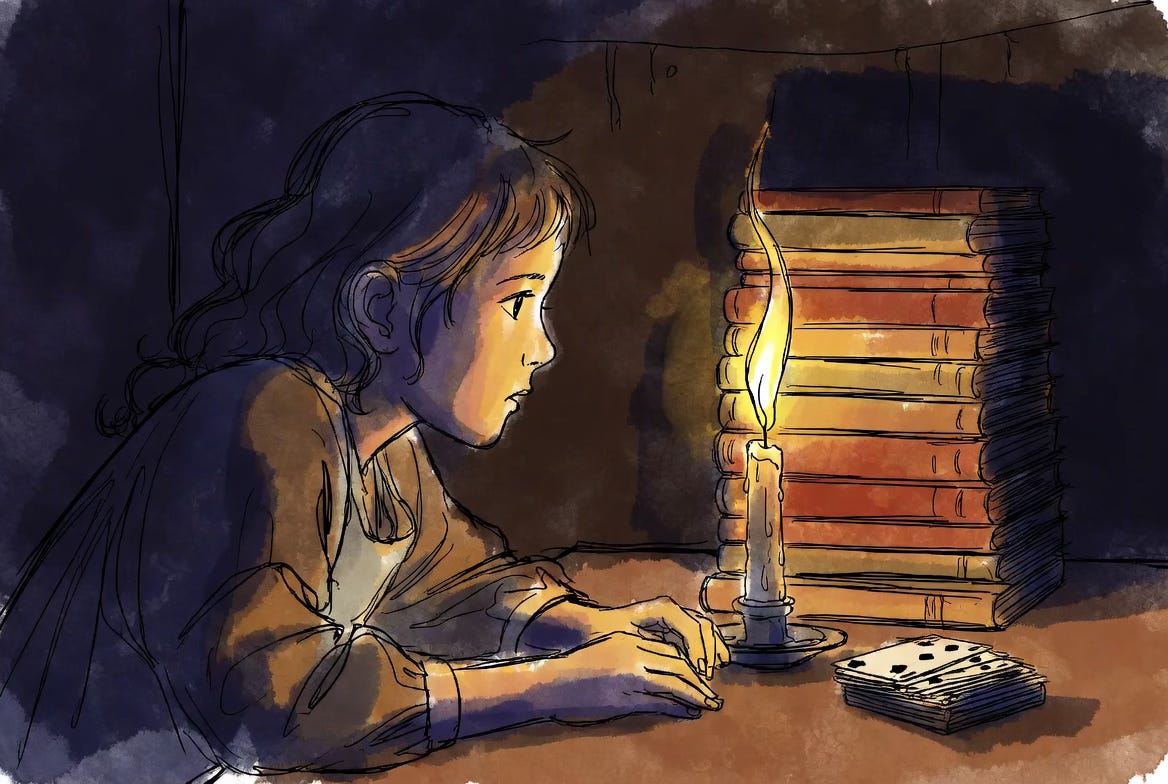
If you don’t know it: Roald Dahl writes about a young man who learns about an Indian yogi who could see without his eyes. The yogi trained by sitting in front of a candle for hour after hour, year after year, directing his attention until he could read the words on a page held against his chest, then read playing cards face-down, then riding a bicycle through traffic completely blindfolded. He learned this technique from another mysterious yogi who could — and here is where Dahl skips a beat that an eight-year-old could not skip — levitate.
I sat with this for a long time. Could trained yogis really levitate, or was Roald Dahl just making it up? Dahl was so persuasive — so specific about the candle, the meditation, the years of practice. The whole structure of the story depends on you taking it seriously. And the levitation isn’t even the climax. The climax is Henry Sugar using the technique to win at casinos and then turning his life over to charity. The levitation is just one of the things on the way.
Somewhere in there I decided I would try it. Not the levitation — even at eight I could tell that was the deepest part of the well — but the candle. The basic technique. I would sit cross-legged in my room with a candle and stare at it until I could see through cards. I tried for ten minutes at a time, which felt like an hour. I lost track of how many times I tried. Whenever an adult came in they got mad about the candle, and I’d blow it out without explaining. Adults in the eighties didn’t probe the inner workings of a child’s mind. They told you to come down for dinner
I also tried other things. I was nine, in grade five at St. Clement’s in Toronto — a very proper academic school, not a place for silly nonsense. I rode the Yonge subway by myself from Rosedale. I’d stand on the platform and try to make the subway doors stop right in front of me. I had about 60% accuracy. Not much better than chance. But I didn’t trust myself to report accurately, and dared not tell anyone else what I was doing.
I tried card-reading. I tried predicting which song would come on the radio. I tried, once, to roll through my very molecules of my bedroom wall — though that one was less an experiment than a precaution, after a Twilight Zone episode where a girl my age rolled through the wall in her sleep and ended up in an alternate dimension. I was terrified of my own wall for months. Don’t fall asleep too close to it. I worked all of this out by myself, without a mentor. There was no one I could have told. None of the adults in my life would have understood what I was doing, or — worse — they would have understood exactly what I was doing and gently steered me away from it.
Which is what they did. Not unkindly. I was a very bright child, but prone to depression and anxiety, and the consensus among the adults in charge of me was that leaning into imaginary things wasn’t going to help. I needed to be steered toward the practical: paint pictures, write stories, learn to be independent and capable in case no one else turned out to be willing to look after me. Painting and writing were mainstream enough. Painting and writing were how a girl with my temperament could earn her place in the consensus reality without too much trouble.
What I actually wanted was something uncharted. Swiss Family Robinson. A convent. A levitating yogi deep in the jungle. (I am thoroughly grateful, on inspection, that I didn’t end up in a cult.) I wanted the territory the adults were steering me away from, and I didn’t have the vocabulary or the confidence to push back. So I let it go. Reluctantly. The way you let go of anything when every grown-up around you has decided you should.
It took me about forty years to come back to the question. I came back through quantum physics, something I loved in high school. The double-slit experiment will find anyone who is willing to sit with it long enough. Particles behave one way when they’re observed and another way when they’re not. The act of observation is generative. The world the adults told me was solid is, at its foundation, doing something stranger than they ever wanted to admit.
I am not going to tell you I can stop subway cars now. I can’t. I can’t read cards through their backs either. I’m fifty-one and I still live in the consensus reality where most of the time, gravity wins and the train stops where the driver wants it to. But I no longer believe the adults were right. I believe they were doing what every culture does to every bright child who senses something — they were settling me, gently, so I could function.
The Deprogramming is the work of unsettling.
The kid with the candle was right.
I’m forty-three years late, but I’m coming back for her.
- Swith